
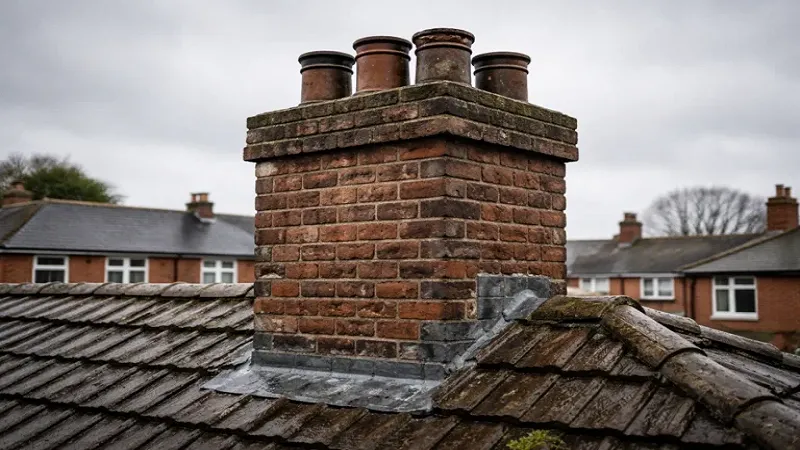
A chimney can look perfectly solid from the street and still be the reason the back bedroom smells of damp. The first sign is often a brown mark on the ceiling, just off the stack, after a few days of rain. By then water has usually been getting in at the flashing, the flaunching or a cracked joint for some time.
We spend a lot of visits on stacks rather than on the main covering, especially on older sandstone houses. Here’s what tends to fail, how to decide between a repair and a rebuild, and what the work typically costs in Carlisle in 2026.
What Actually Fails on a Stack
Most leaks at a chimney don’t start in the middle of the brickwork or the stone. They start where the stack meets the roof, or at the very top.
The flashing (the lead, or sometimes a felt substitute, dressed around the base) is the usual culprit. It can split, pull away from the mortar, or get lifted by wind. Cheap felt flashings fail earlier than lead, and they fail faster in wet, windy weather.
Above that, the flaunching (the cement cap that holds the pots) cracks with frost and movement. Once it’s open, rain goes straight down the stack or into the work below. Pots themselves loosen, lean, or lose their cowls. Mortar joints, particularly on older sandstone, wash out and let water into the core of the chimney.
Unused stacks are often worse than live ones. They sit cold and damp, with no warmth to dry them, and they get ignored until a stain appears.
Please don’t go onto the roof to have a look. Binoculars from the garden will show a lean, a cracked pot, missing pointing and any obviously lifted flashing. A torch in the loft, around the chimney breast, will show staining, damp timber and, sometimes, daylight where the flashing has opened.
Fix, Rebuild or Take It Down
Not every stained ceiling means a new chimney. A straight way to think about it:
- Sound stack, failed flashing or cracked flaunching: repair it. Re-dress or replace the lead, renew the flaunching, and repoint what’s loose. That solves most of the leaks we see.
- Pots loose, joints washed out, but the body of the stack still true: a fuller repair, sometimes with a rebuild of the top few courses, is usually enough.
- The stack is leaning, the stone or brick is crumbling, or it’s moving at the roof line: that’s a rebuild, or a partial rebuild down to sound work. It is not a job for another coat of cement.
If the chimney is redundant and in poor shape, taking it down to below the roof line and tiling or slating over, with the breast left in place downstairs if you want it, can be cleaner and cheaper than rebuilding. That may need Building Control, and on a terrace you have to think about the neighbour’s side and any shared flues. Don’t close a flue or cap a pot on a fireplace you still use, or might use, without someone checking the ventilation; a blocked stack is a carbon monoxide risk, not just a roofing detail.
When people book Roof Repairs Carlisle, we would rather give you that choice with photos than sell the biggest job on day one. A flashing repair on a sound stack is a very different price from a rebuild, and you should see why we are recommending one or the other.
Sandstone, Slate and a Wet Climate
A lot of the older housing, in streets around Denton Holme, Currock, Stanwix and the older parts of Botcherby, is sandstone with slate roofs. Sandstone soaks and then sheds its face if the pointing is hard and impermeable, or if water has been running through the stack for years. Repairs need a mortar that suits the stone, not a dense cement mix that looks tidy and then blows the surface off.
Slate roofs make the junction at the base of the chimney more particular. The lead has to be stepped and dressed properly, and a felt patch at that joint is a short-term answer. Later houses in Harraby and Belah are more often brick with concrete tiles, and those stacks fail in more ordinary ways: flaunching, pots and a simple flashing.
The climate does the rest. Rainfall is high, and winds off the Solway and the west find any loose pot or lifted edge of lead. Cumberland Council is the planning authority now. Like-for-like repairs on an ordinary house are usually straightforward. Listed buildings, conservation areas and taking a stack down entirely should be checked before work starts.
What Chimney Work Typically Costs
Typical 2026 prices, including labour and materials, for a standard two-storey house. Access is a large part of the bill, because a stack is awkward to reach safely.
- Inspection with photos, including the loft: £80 to £180
- Re-dressing or renewing lead flashings at the base: £250 to £950
- New flaunching and refitting pots or cowls: £200 to £600
- Repointing a sound stack: £300 to £1,200, depending on height and the mortar needed
- Rebuilding the top section (a few courses and the pots): £800 to £2,500
- Full rebuild of a single stack: often £2,000 to £5,500
- Taking a redundant stack down and making the roof good: £1,200 to £3,500
- Scaffold: £600 to £1,800, more on a mid-terrace or a steep slate roof
A quote should say whether the lead is being replaced or just re-dressed, what mortar will be used on stone, and whether the pots are being reused. “Fix chimney” is not a specification.
Hiring and Doing the Job Safely
This is not a cash-in-hand afternoon on a ladder. You want public liability insurance of at least £2 million, a written quote, and a deposit of no more than 20 to 30 percent. NFRC or TrustMark membership is a useful filter. If the work includes taking a stack down or altering flues, ask who is notifying Building Control.
After a storm, be cautious of callers who have “spotted” a leaning pot from the road. A temporary sheet or a temporary cowl can make the house safe; the permanent repair can wait for a firm you have chosen.
Roof Repairs Carlisle will look at the flashing, the pot and the condition of the stack and tell you whether it’s a lead job, a rebuild, or a candidate for taking down. A short guarantee on flashings and flaunching is normal. A longer one should be in writing.
If you’ve got a stain below a chimney and you’re not sure whether it’s a flashing or something more, get in touch with Roof Repairs Carlisle.
Frequently Asked Questions
How much does chimney repair cost in Carlisle?
Lead flashings are typically £250 to £950. Flaunching and pots often sit between £200 and £600. A partial rebuild of the top of the stack is usually £800 to £2,500, and a full rebuild can run from £2,000 to £5,500. Scaffold, where needed, is often £600 to £1,800.
Can I just have the flashing replaced?
Yes, if the stack itself is sound. That’s the most common and the most cost-effective repair. If the flaunching is cracked or the pots are loose, do those at the same time, while the access is already there.
Do I need permission to take a chimney down?
Often you will need to involve Building Control, and listed or conservation properties can need planning consent as well. On a terrace, the neighbour’s structure and any shared flues have to be considered. Check with Cumberland Council, or ask the roofer to, before anyone starts taking stone off.
Why is an unused chimney more likely to leak?
It stays cold and damp, so the masonry never really dries, and it gets less attention than a stack that’s in daily use. The flashing and the flaunching still weather. A cap or cowl, plus a sound flashing, will often settle it without a rebuild.
Is it safe to delay if the leak only shows in heavy rain?
A small flashing leak can soak timbers and plaster for a long time before it looks dramatic. You don’t need to panic, but you shouldn’t ignore it either. A survey with photos will tell you whether it can wait for a booked repair or needs sheeting in the meantime.